
Steam Frame's Wireless VR Dongle Passes a One-Man Field Test
A VR channel says Steam Frame's dedicated dongle finally makes wireless PC VR look artifact-free across five titles. One tester's headset isn't a benchmark suite, so here's what actually held up.
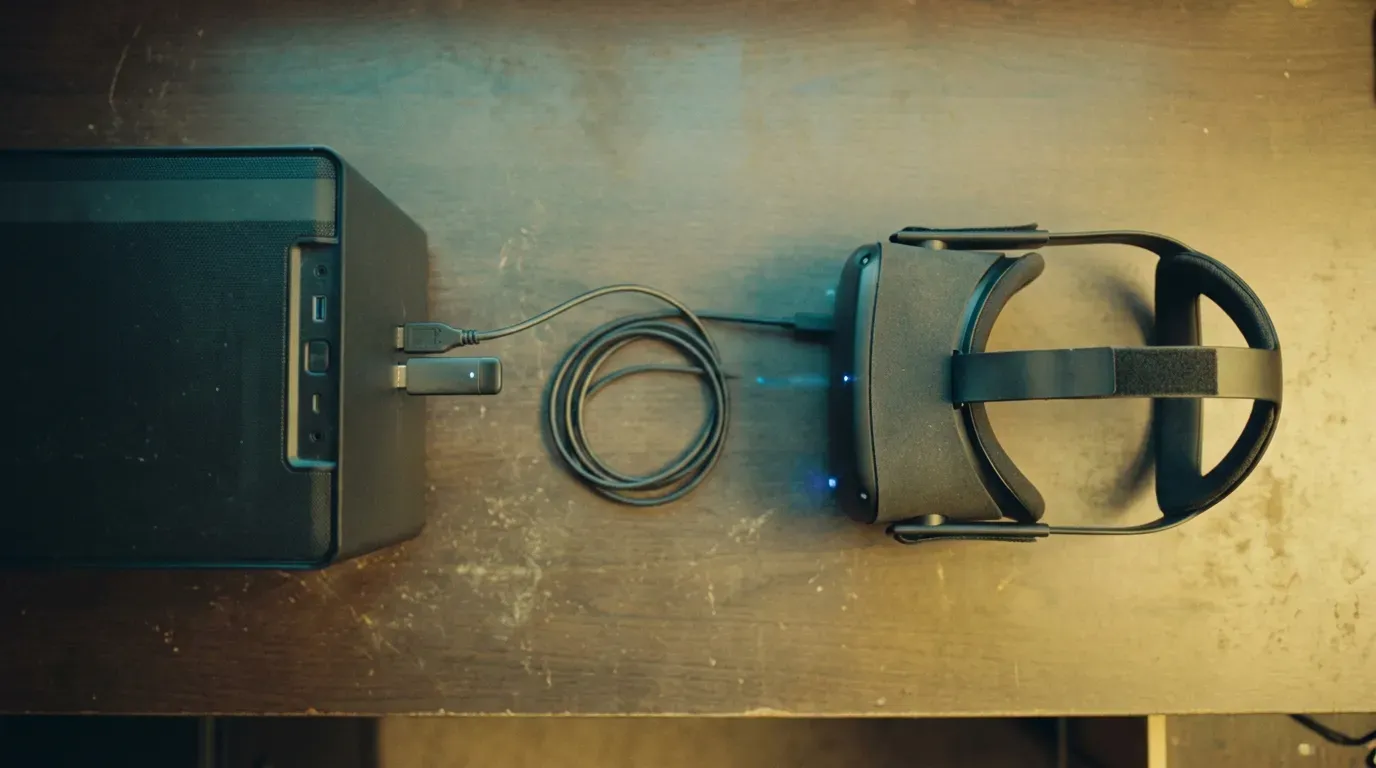
Beardo Benjo says Steam Frame's wireless dongle just solved PC VR streaming, no artifacts, no compression, five VR experiences deep. That's a hell of a claim for a piece of plastic that plugs into a USB port, so it earns the same scrutiny any wireless standard would get.
The channel ran the dongle against five separate PC VR workloads: native titles, full VR mods, and content pushed through UEVR, the injector that forces flatscreen games into a headset. The Elder Scrolls V: Skyrim VR made the lineup, run standalone rather than through a flatscreen port. The point of the test wasn't the games themselves, it was whether the wireless pipe carrying them held together.
What "No Compression" Actually Means
Here's the deflating parenthetical every wireless VR claim earns eventually: "no noticeable artifacts" is a description from one viewer's eyes on one setup (his router, his room, his headset, his tolerance for latency), not a spec sheet. Beardo Benjo reported the dongle handled all five experiences without visible compression breakdown, which is a real result worth logging, but it's one tester's session, not a benchmark suite with frame time graphs or bitrate numbers attached to it.
That distinction matters because "wireless PC VR is basically solved" has been the pitch of every headset since the first standalone wireless adapters showed up with a battery pack and a prayer. The promise repeats every generation: strap it on, cut the tether, forget the compression exists. Sometimes it holds for a session. Sometimes it falls apart the moment you snap your head sideways in a fight. The only way to know which one you got is to run it yourself and watch for the hitch, not take a single glowing session as gospel.
Why the Dedicated Hardware Angle Holds Up
Steam Frame's dongle is purpose-built point-to-point hardware for this exact pairing, rather than asking a general Wi-Fi router to behave itself under load. That's a genuinely sound engineering call: fewer shared-network variables, fewer neighbors' routers to blame. It tracks with a platform that has been patching fast since launch, as SteamOS 3.8.28 Ships With Real Fixes, Not Just Promises showed with actual driver and memory fixes rather than promises, and as Steam Frame's First Update Finally Fixes Its Charging Crawl showed by killing a charging bug and a garbled mic within days of release.
None of that turns one video's five-game session into a verdict on the hardware generation. It makes it a data point worth repeating on your own network, in your own room, with your own patience for a dropped frame at the worst possible second in a horror mod.
The real test isn't whether the dongle worked once for one channel. It's whether it keeps working after the novelty wears off and the router next door starts arguing for bandwidth.